01
Start early with a (research data management) plan
(7 topics
)
As with most significant endeavours in life, it’s useful to start image data management as early as possible, but at the same time, you should know what you are getting into. Leaving the house without preparation might prove challenging, regardless of how early you start.
In the realm of Research Data Management (RDM), preparedness for the journey can be best measured by your Data Management Plan (DMP). This chapter isn't a magic fix for RDM. Whether your institution calls it RDM, data stewardship, or data management and sharing, our goal here is simple: to share real-world experience and tips for building a Data Management Plan that sets you up for success.
A DMP (also known as Research Data Management Plan) is a document that describes the activities related to the creation, organisation, documentation and dissemination of data throughout a research project from initial planning, day-to-day data management and curation, to long-term preservation, reusing, and sharing (Michener 2015). Because data management is a continuous and iterative process, a DMP should be treated as a living document, that is one that evolves alongside the project itself. Consequently, a DMP documents key information about the data created, accessed, or reused during a project or a research activity, thereby covering not only the properties of the data, but also the actions, rules, and procedures that apply to them during and after the completion of the project or activity, and throughout the research data management life cycle illustrated in Figure 1.
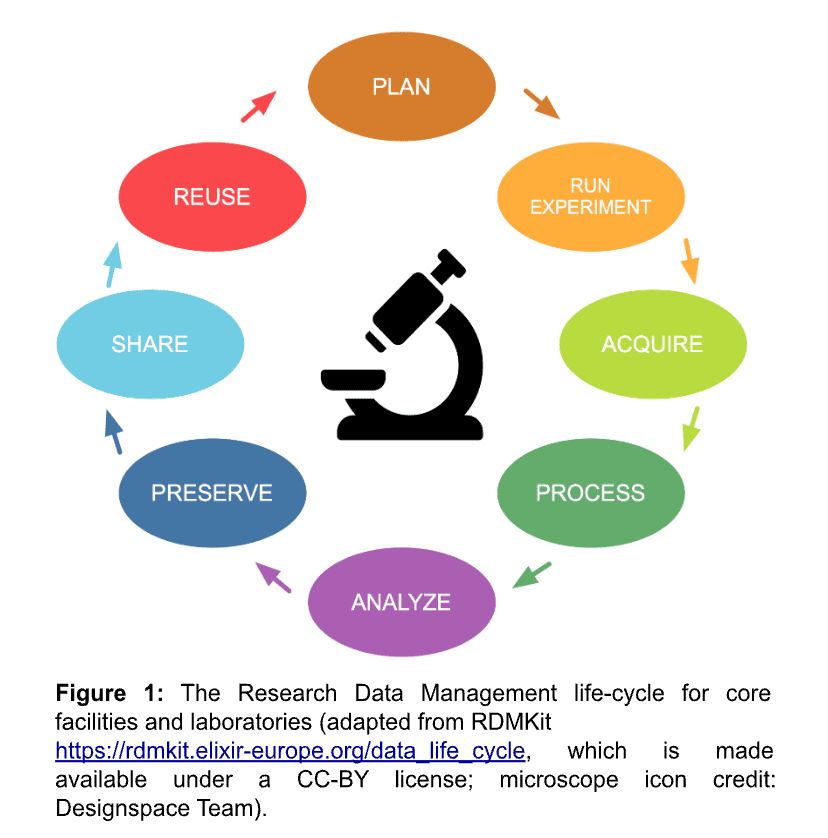
At the institutional or facility level, however, DMPs and DMP templates provided to users can serve a broader strategic purpose. Not only do they direct researchers towards existing resources, but the patterns and needs that emerge from them can also help identify the most pressing infrastructure gaps. In this sense, a DMP can act as a starting point for planning which infrastructure changes should be prioritised and followed up on, making it a valuable instrument for both individual research practice and institutional development.
As stated earlier, a DMP is a dynamic document. It is more than a mere "compliance" or box-ticking exercise. Instead, it can and should be an actionable document that serves as a blueprint to plan what measures will need to be taken towards best practices in data management, and that evolves as a project or an activity evolves over time. It is thus advised to update a DMP periodically or when a specific need arises (e.g. when a research project reaches a milestone or starts dealing with sensitive data, or when a facility acquires a new instrument with specific resources required for data storage and transport).
In today's research environment, best practice is to start a DMP before a project starts. In fact, some funders may require a DMP as a prerequisite for funding; e.g. at the time of proposal submission, before funding is released, or when the funded project starts. Let's dream big and embrace this best practice here!
Under the impetus provided by funding agencies, an increasing number of research institutions are encouraging research and imaging scientists, including trainees, interns, PhD candidates, graduate (or postgraduate) students, as well as early- and mid-career researchers, to develop DMPs.
National DMP: A national DMP is a high-level framework established by a national funding body or research agency that sets out the minimum requirements and standards for data management that grant recipients are expected to meet.
Institutional DMP: An institutional DMP is a policy-level document produced by a university or research institution that defines the data management expectations, responsibilities and available resources applicable to all researchers working within that organisation.
Facility DMP: A facility DMP is a document produced by a research facility that outlines the data management tools, infrastructure and procedures available to its users, as well as the rules governing data generated through its services. A facility DMP carries an institutional responsibility and ensures that the facility actively implements necessary tools and procedures, and engages with its users to ensure they can derive maximum benefit from their own DMPs.
Laboratory DMP: A laboratory DMP is a document maintained at the research group level that describes how a particular laboratory manages, stores and shares its data, reflecting the specific workflows and resources used by that group. Project DMP: A project DMP is a document tied to a specific research project that details how data will be collected, organised, stored, shared and preserved throughout and beyond the duration of that project.
Individual DMP: In some instances, a person such as a trainee or a PhD candidate, is encouraged to develop a personal DMP outlining how they will manage research data both during and after their project, including storage, retention, access, sharing and publication.
In general, a DMP contains the following information:
Importantly, funders or sponsors of a research project may have particular requirements on some aspects of data management, such as data sharing, ethics, access rules and security for sensitive data. DMPs can be used to ensure compliance with regulatory and legislative requirements. This is especially relevant in the case of sensitive and clinical data that require compliance with their national or supranational specific personal data-protection laws and regulations such as the European Union’s General Data Protection Regulation (GDPR), Japan’s Act on the Protection of Personal Information (APPI), China’s Personal Information Protection Law (PIPL) and Australia's Privacy Act that should be addressed explicitly in a DMP. In the United States, the National Institutes of Health (NIH) has underscored the importance of data sharing by referring to DMPs as “Data Management and Sharing Plans” (DMSPs). Researchers are thus required to provide a DMSP with the explicit intent from NIH to encourage data sharing whenever possible (Nelson 2022). Similarly, other activities related to data may be highlighted in DMPs, such as data security in Data Management and Security Plans at the University of Vermont, Texas State University College of Applied Arts and North Carolina State University, and data storage in Data Management and Storage Plan at Charles Sturt University in Australia.
In countries such as Finland and Australia, some core research facilities and broader research infrastructures may be formally required to develop a DMP alongside those of the individual researchers who use their services. Even where no such obligation exists, facilities are strongly encouraged to do so, as a facility DMP ensures that appropriate strategies are in place to manage the volume and flow of data generated by their instruments and to anticipate evolving needs. Beyond its internal value, a facility DMP can also meaningfully complement a researcher's DMP by clearly defining the roles and responsibilities of both parties with respect to data access, storage, transfer, retention, and disposal — encompassing both archiving and destruction — of all data created at the facility.
When getting started with a Data Management Plan, it is important to seek guidance from your institution. Good first points of contact are your local library, research management office, research computing office, IT department or eScience, eResearch or cyberinfrastructure department, as these are the most likely sources of guidance on the data management policies applicable to your research laboratory or core facility. If no institutional guidance is available, local colleagues or bioimaging communities can be a valuable resource.
The following sites also provide general guidance to help you get started:
NOTE: For a list of country specific policies please consult the endnote of this chapter.
While tools guiding researchers in the task of writing DMPs are being developed (Textbox 2), it is often unclear to what extent such documents should be considered actionable and serve as the basis for developing effective strategies leading to the production and management of research data that is FAIR from the start. This is particularly relevant for image data.
Despite this potential confusion, the increased attention devoted to DMPs represents an opportunity to raise awareness among research and imaging scientists — including trainees, students and PhD candidates — about the importance of RDM, and to encourage them to proactively address its challenges. For example, at Leiden University (Netherlands), and The University of Sydney (Australia), completion of a DMP is a formal prerequisite for PhD candidature (see Textbox 1, Individual DMP). Other institutions have leveraged nationwide DMP policies to develop training and educational resources for their researchers, while others have established centralised RDM cores that support researchers through consultations, training, data curation and archiving, and access to data management tools and infrastructure.
To ensure that mandatory DMPs drive a genuine paradigm shift towards best RDM practices, it is essential to foster awareness among research and imaging scientists that effective RDM can meaningfully streamline their work. DMPs should therefore not be viewed as mere compliance documents, but as practical blueprints for defining the RDM measures needed to ensure the smooth execution of a research project. In this spirit, researchers and imaging scientists should be encouraged to think early and deliberately about the RDM strategies required for their imaging data, and to capture these in a well-crafted DMP.
In this context, DMP writing tools could actually become useful for researchers to think about their data, and what will be required to ensure that:
For example, the writing of a DMP could help researchers and imaging scientists prepare their projects and experiments, by inquiring early about:
By promoting early planning and thinking about the execution of DMPs, researchers will increasingly reduce the anxiety related to the burdensome aspects of RDM and instead think of RDM as a useful tool.
Argentina Law 26.899 (2013) mandates open access digital repositories for all publicly funded research outputs, including data. The Ministry of Science (MINCYT) oversees implementation via the National System of Digital Repositories (SNRD). The 2022 Open Science diagnosis and guidelines document provides the current policy framework: https://back.argentina.gob.ar/sites/default/files/2023/01/documento_final_comitecayc-_dic_22.pdf
Australia The country has a well-developed RDM policy framework, though it is distributed across several complementary instruments rather than a single national mandate. Key documentation can be found here: ARC Research Data Management page: https://www.arc.gov.au/about-arc/arc-strategies-and-policies/international/research-data-management Management of Data and Information in Research Guide: https://www.nhmrc.gov.au/sites/default/files/documents/attachments/Management-of-Data-and-Information-in-Research.pdf ARDC (national data infrastructure and guidance): https://ardc.edu.au/
Brazil There is no single enacted national RDM law, but FAPESP (São Paulo Research Foundation) has required DMPs for thematic projects since 2014 and is the most advanced funder in this area. A national Open Science policy has been in development under the MCTI. FAPESP's open science page: https://fapesp.br/openscience/en
Canada The Tri-Agency Research Data Management Policy (CIHR, NSERC, SSHRC), launched March 2021, requires institutional RDM strategies, DMPs, and data deposit: https://science.gc.ca/site/science/en/interagency-research-funding/policies-and-guidelines/research-data-management/tri-agency-research-data-management-policy
China The State Council issued the Measures for Managing Scientific Data in April 2018, the first national-level RDM policy in China. The National Natural Science Foundation of China (NSFC) also requires data deposit for funded projects. Mandarin: https://www.gov.cn/zhengce/content/2018-04/02/content_5279272.htm English overview: https://datascience.codata.org/articles/10.5334/dsj-2021-003
European Union The EU mandates RDM and open data through the Horizon Europe programme. A broad overview of the EU data strategy is here: https://digital-strategy.ec.europa.eu/en/policies/strategy-data
Finland Finland has a comprehensive national framework through the Declaration for Open Science and Research (most recent edition 2025–2030), coordinated by the Federation of Finnish Learned Societies, and reinforced by the Research Council of Finland's open science requirements. The national open science portal: https://www.avointiede.fi/en Research Council of Finland open science policy: https://www.aka.fi/en/research-funding/responsible-science/open-science/
France The French National Plan for Open Science (first 2018, second 2021–2024) mandates DMPs for all ANR-funded projects and promotes open data sharing. The ANR policy page: https://anr.fr/en/anrs-role-in-research/commitments/open-science/ The official plan: https://www.enseignementsup-recherche.gouv.fr/en/second-french-plan-open-science-87949 Guide for grant applicants: https://www.aka.fi/en/research-funding/apply-for-funding/how-to-apply-for-funding/az-index-of-application-guidelines2/data-management-plan/data-management-plan/
Germany The German Research Foundation (DFG) sets expectations through its Guidelines for Safeguarding Good Research Practice (2019). The National Research Data Infrastructure (NFDI; https://www.nfdi.de/) provides discipline-specific data management frameworks: https://www.dfg.de/resource/blob/172098/b08fcad16f1ff5ddca967f1ebde3a8c3/guidelines-research-data-data.pdf More detailed information can be found at these sites: https://rdmorganiser.github.io/en/ https://base4nfdi.de/projects/dmp4nfdi https://knowledgebase.nfdi4chem.de/knowledge_base/docs/dmp/ https://zenodo.org/records/16737079 https://dmpg.nfdi4plants.org/ https://www.fairmat-nfdi.eu/uploads/documents/Tutorial%20documents/Templates_final.pdf
India India has a National Data Sharing and Accessibility Policy (NDSAP) (2012) covering government-held data, and the Science, Technology and Innovation Policy (STIP) 2020 draft proposed an Open Science Framework for publicly funded research, but a dedicated, enacted national RDM policy for research data specifically remains under development. The NDSAP: https://dst.gov.in/national-data-sharing-and-accessibility-policy-0
Italy The Piano Nazionale per la Scienza Aperta (PNSA), established by ministerial decree in February 2022 (Decree n.268), is Italy's national open science plan covering research data, DMPs, and EOSC alignment. Compliance is mandatory for MUR-funded research: Italian: https://researchitaly.mur.gov.it/en/2022/07/15/national-plan-for-open-science-published-by-the-mur/ English: https://www.mur.gov.it/sites/default/files/2023-01/PNSA_2021-27_ENG.pdf
Japan The Japan Science and Technology Agency (JST) policy on open access and research data management (first adopted 2017, updated 2022) requires DMPs for funded projects and promotes FAIR principles. The Cabinet Office also issued a Basic Concept on Management and Utilization of Publicly Funded Research Data (2021). JST policy overview: https://www.jst.go.jp/EN/about/openscience/guideline_openscience_en_r4.pdf National policy developments tracker: https://rcos.nii.ac.jp/en/openscience/internal/ Japan Society for the Promotion of Science (JSPS) policy requiring that all research activities funded by the Grants-in-Aid for Scientific Research must be made publicly available immediately after the related paper is published. https://www.jsps.go.jp/j-grantsinaid/01_seido/10_datamanagement/
Mexico Mexico has an open government data policy and a National Repository (managed by CONAHCYT) for publicly funded research outputs, but a comprehensive, dedicated national RDM policy is not yet formally in place. The national repository: http://repnaldev.conacyt.mx/
Netherlands The Dutch Research Council (NWO) has maintained an RDM policy since 2016 (last revised 2020), requiring grant applicants to submit a data management plan and deposit data in a trusted repository following FAIR principles. Within NWO, Open Science NL, was established to drive the national open science transition. NWO Research Data Management: https://www.nwo.nl/en/research-data-management Open Science NL: https://www.openscience.nl/en NWO Open Science overview: https://www.nwo.nl/en/open-science NWO RDM policy revision: https://www.openscience.nl/en/cases/nwo-research-data-management-policy-revision-started
South Africa The National Research Foundation (NRF) Open Access Statement (effective March 2015) requires data deposit in accredited open-access repositories for NRF-funded research. The NRF and DIRISA also provide a DMP template: https://www.nrf.ac.za/ The NRF statement and DMP guidance are accessible through institutional library pages, e.g.: https://ufs.libguides.com/c.php?g=977378&p=7067126
Switzerland The Swiss National Science Foundation (SNSF) requires a DMP for all funded projects, underpinned by the national Open Research Data (ORD) Strategy (adopted 2021): https://www.snf.ch/en/dMILj9t4LNk8NwyR/topic/open-research-data The national ORD strategy portal: https://openresearchdata.swiss/
United Kingdom The UK's RDM landscape is regulated by UK Research and Innovation (UKRI). In December 2024, UKRI announced a new pan-UKRI research data policy framework, with a draft published in April 2025, updating expectations for data management plans and FAIR data principles. Key information can be found here: UKRI Research Data policy page: https://www.ukri.org/manage-your-award/publishing-your-research-findings/making-your-research-data-open/ UKRI new policy framework announcement: https://www.ukri.org/news/ukri-developing-new-research-data-policy-framework/ UKRI draft policy consultation hub: https://engagementhub.ukri.org/ukri-openresearch/developing-ukris-research-data-policy/
United States The NIH Data Management and Sharing (DMS) Policy, effective January 2023, requires a DMP for all NIH-funded research generating scientific data. NSF similarly requires DMPs. The primary NIH policy site: https://sharing.nih.gov/data-management-and-sharing-policy The DMPTool website: https://dmptool.org/

This project has been made possible in part by a grant from the Chan Zuckerberg Initiative DAF, an advised fund of Silicon Valley Community Foundation.